Actualisation


Captures d’écran iPhone

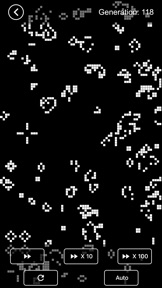


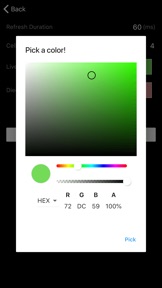

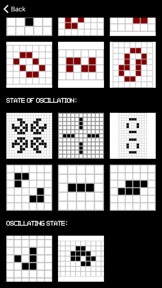

Captures d’écran iPad



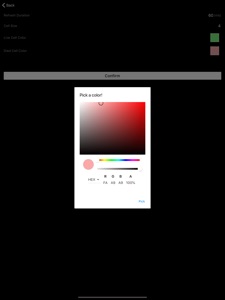

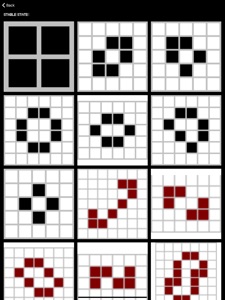

Description
The Game of Life (an example of a cellular automaton) is played on an infinite two-dimensional rectangular grid of cells. Each cell can be either alive or dead. The status of each cell changes each turn of the game (also called a generation) depending on the statuses of that cell's 8 neighbors. Neighbors of a cell are cells that touch that cell, either horizontal, vertical, or diagonal from that cell.
The initial pattern is the first generation. The second generation evolves from applying the rules simultaneously to every cell on the game board, i.e. births and deaths happen simultaneously. Afterwards, the rules are iteratively applied to create future generations. For each generation of the game, a cell's status in the next generation is determined by a set of rules. These simple rules are as follows:
If the cell is alive, then it stays alive if it has either 2 or 3 live neighbors
If the cell is dead, then it springs to life only in the case that it has 3 live neighbors
There are, of course, as many variations to these rules as there are different combinations of numbers to use for determining when cells live or die. Conway tried many of these different variants before settling on these specific rules. Some of these variations cause the populations to quickly die out, and others expand without limit to fill up the entire universe, or some large portion thereof. The rules above are very close to the boundary between these two regions of rules, and knowing what we know about other chaotic systems, you might expect to find the most complex and interesting patterns at this boundary, where the opposing forces of runaway expansion and death carefully balance each other.
Nouveautés de la version 0.1.6
Bug fixed and performance improvements
Vendeur
Nom
Ruifeng Yu
Informations
Éditeur
Catégories
Version
0.1.6
Taille
51,9 MB
Game Center
Non
VPP Device Licensing
Oui
Classement
Classification : 4+
Compatibilité
iOS 8.0 ou plus récent
Appareils
iPhone 4S, iPhone 5, iPhone 5c, iPhone 5s, iPhone 6, iPhone 6 Plus, iPhone 6s, iPhone 6s Plus, iPhone SE, iPhone 7, iPhone 7 Plus, iPhone 8, iPhone 8 Plus, iPhone X, iPhone XR, iPhone XS, iPhone XS Max, iPhone 11, iPhone 11 Pro, iPhone 11 Pro Max, iPhone SE (2e génération), iPhone 12, iPhone 12 Pro, iPhone 12 Pro Max, iPhone 12 mini, iPhone 13, iPhone 13 Pro, iPhone 13 Pro Max, iPhone 13 mini, iPhone SE (3e génération), iPhone 14, iPhone 14 Plus, iPhone 14 Pro, iPhone 14 Pro Max, iPad 2 (Wi-Fi), iPad 2 (3G), iPad (3e génération) (Wi-Fi), iPad (3e génération) (4G), iPad (4e génération) (Wi-Fi), iPad (4e génération) (4G), iPad (5e génération) Wi-Fi, iPad (5e génération) Wi-Fi + Cellular, iPad (6e génération) Wi-Fi, iPad (6e génération) Wi-Fi + Cellular, iPad Pro, iPad mini 4 (Cellular), iPad Pro (9,7 pouces), iPad Pro (9,7 pouces) (Cellular), iPad Pro 12,9 pouces (2e génération), iPad Pro 12,9 pouces (2e génération) Wi-Fi + Cellular, iPad Pro (10,5 pouces), iPad Pro (10,5 pouces) Wi-Fi + Cellular, iPad Pro (11 pouces), iPad Pro (11 pouces) Wi-Fi + Cellular, iPad Pro 12,9 pouces (3e génération), iPad Pro 12,9 pouces (3e génération) Wi-Fi + Cellular, iPad Air, iPad Air (Cellular), iPad Air 2, iPad Air 2 (Cellular), iPad Air (3e génération), iPad Air (3e génération) Wi-Fi + Cellular, iPad mini (Wi-Fi), iPad mini (4G), iPad mini Retina, iPad mini Retina (Cellular), iPad mini 3, iPad mini 3 (Cellular), iPad mini 4, iPad mini 4 (Cellular), iPad mini (5e génération), iPad mini (5e génération) Wi-Fi + Cellular, iPad (7e génération) Wi-Fi + Cellular, iPad Pro 11 pouces (2e génération), iPad Pro 11 pouces (2e génération) Wi-Fi + Cellular, iPad Pro 12,9 pouces (4e génération), iPad Pro 12,9 pouces (4e génération) Wi-Fi + Cellular, iPad Air (4e génération) (Wi-Fi), iPad Air (4e génération) (Wi-Fi + Cellular), iPad (8e génération) Wi-Fi, iPad (8e génération) Wi-Fi + Cellular, iPad Pro 11 pouces (3e génération), iPad Pro 11 pouces (3e génération) Wi-Fi + Cellular, iPad Pro 12,9 pouces (5e génération), iPad Pro 12,9 pouces (5e génération) Wi-Fi + Cellular, iPad (9e génération), iPad (9e génération) Wi-Fi + Cellular, iPad mini (6e génération), iPad mini (6e génération) Wi-Fi + Cellular, iPad Air (5e génération), iPad Air (5e génération) Wi-Fi + Cellular, iPad Pro 11 pouces (4e génération), iPad Pro 11 pouces (4e génération) Wi-Fi + Cellular, iPad Pro 12,9 pouces (6e génération), iPad Pro 12,9 pouces (6e génération) Wi-Fi + Cellular, iPad (10e génération), iPad (10e génération) Wi-Fi + Cellular, iPod touch (5e génération), iPod touch (6e génération), iPod touch (7e génération), Apple Watch Series 4, Apple Watch Series 5, Apple Watch Series 6 (GPS), Apple Watch Series 6 (GPS + Cellular), Apple Watch Series SE (GPS), Apple Watch Series SE (GPS + Cellular), Apple Watch Series 7 (GPS), Apple Watch Series 7 (GPS + Cellular), Apple Watch Series 8 (GPS), Apple Watch Series 8 (GPS + Cellular), Apple Watch SE (2e génération) (GPS), Apple Watch SE (2e génération) (GPS + Cellular), Apple Watch Ultra, Mac Desktop
Langues
anglais, chinois
App Store : Notes
Notes et avis
0,0 sur 5 (Pas de note)
App Store : Avis des utilisateurs
Pas d'entrée